
Byzantine Fault Tolerance and My Thesis
When I first signed up for a thesis topic titled “Fault-tolerant Web Services using Blockchain,” I’ll admit I had a much simpler vision in mind. I expected to build some standard web services with a “sprinkle” of blockchain on top for data integrity.
I couldn’t have been more wrong.
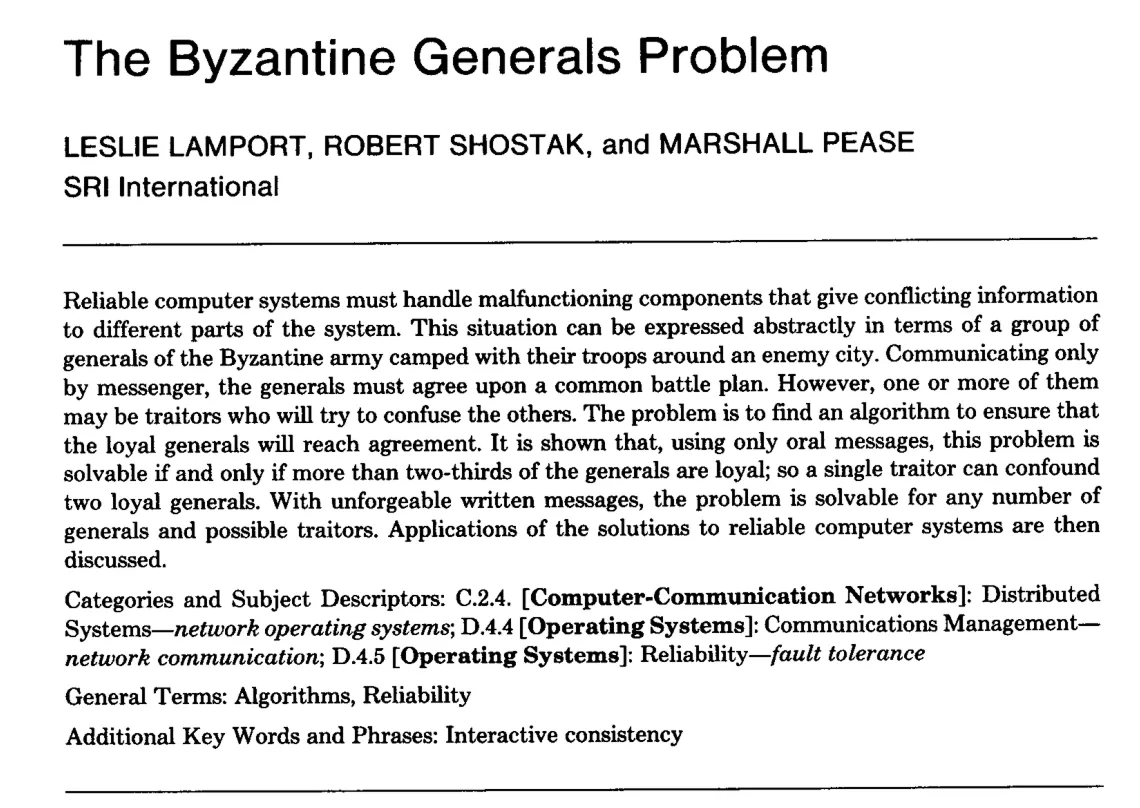
The Byzantine General Problems Paper
Instead of a simple integration project, I fell headfirst into the distributed systems rabbit hole. What followed was months of being surrounded by Leslie Lamport’s foundational papers, the complex logic of quorum math, and the intricate dance of consensus algorithms.
Down the Rabbit Hole
Distributed systems are notoriously difficult because they assume that things will go wrong. My research focused on Byzantine Fault Tolerance (BFT), which is a field that explores how a system can reach a correct agreement even when some of its components are failing or acting maliciously.
To solve the “latency vs. security” tension in these systems, I spent my nights analyzing state machine replication and PBFT (Practical Byzantine Fault Tolerance). I also intensively practice coding Golang and CometBFT for the implmentation. By the end of the journey, I realized I had developed a deeper trust in these mathematical proofs than in my own daily decisions.
The Defense
On July 2, 2025, I officially defended my thesis at Universitas Gadjah Mada.
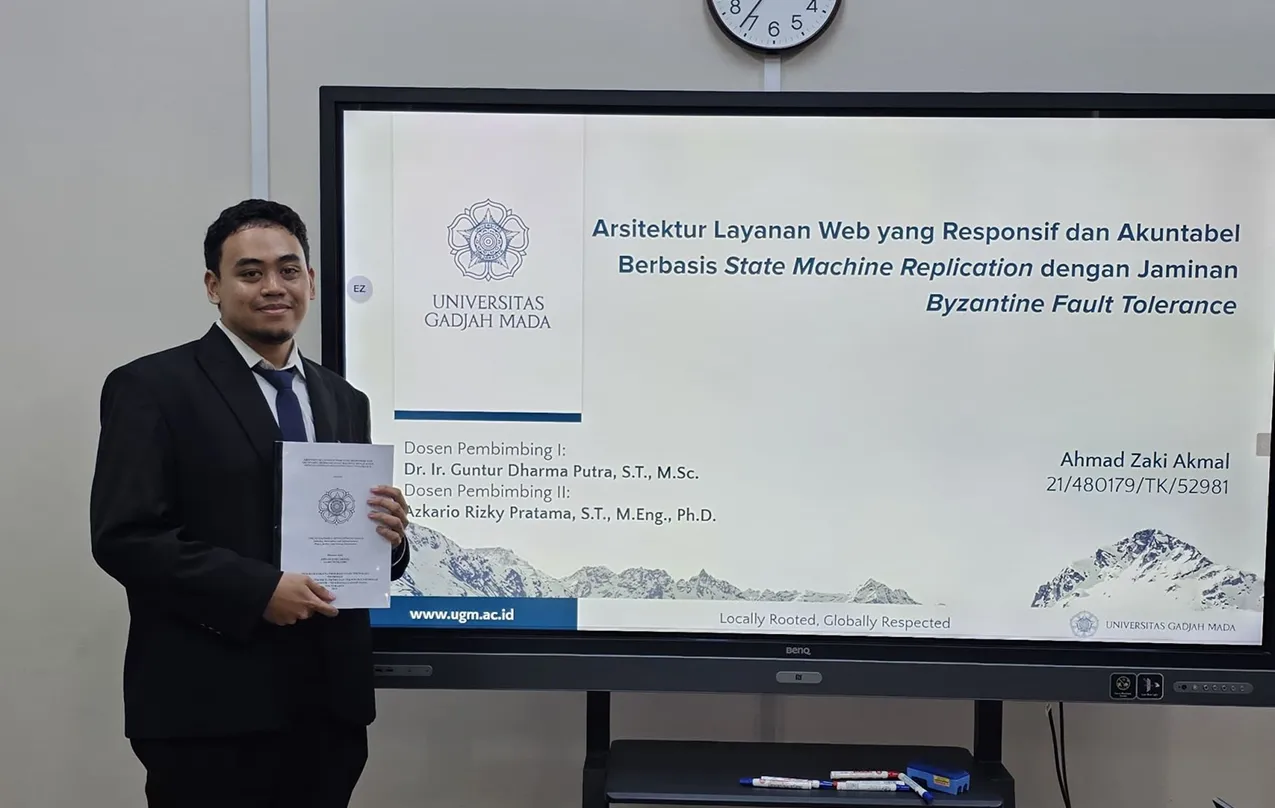
What makes me most proud of this work isn’t just the “Passed” grade. It’s the fact that I chose a path less traveled. BFT and consensus logic aren’t common topics of conversation, even among IT students. It’s a niche, rigorous field that requires a bridge between theoretical computer science and practical software engineering.
This research eventually became the foundation for my publication at IEEE MetaCom 2025, proving that the “rabbit hole” was worth the dive.
Alhamdulillah, thesis defended! If you’re also weird and interested in distributed systems or the math behind BFT, feel free to reach out, let’s talk about it!*